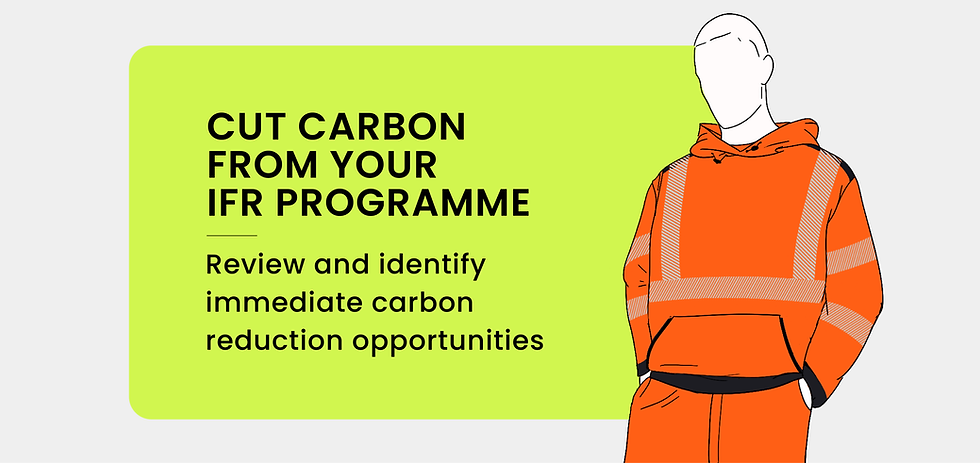
Frequently asked questions about low carbon IFR workwear and PPE

Updated: May 27

Dobtho is introducing the world’s first low carbon inherently flame resistant workwear platform developed specifically to help organisations begin decarbonising IFR workwear without compromising protection, durability, compliance, comfort, or commercial practicality.
Over the past few weeks, Dobtho has discussed the platform with more than 100 organisations across industry, utilities, engineering, PPE, and industrial workwear sectors. The feedback has been consistent. The market recognises this as the first serious low carbon IFR platform designed for real industrial adoption.
Dobtho believes the future of industrial uniforms will be defined not only by protection and durability, but also by measurable reduction in environmental impact. The transition towards lower carbon protective clothing has already started, and Dobtho is helping define what the uniform of the future looks like.
What is decarbonising IFR workwear?
Decarbonising IFR workwear refers to reducing the carbon footprint associated with inherently flame resistant uniforms and protective clothing used across industrial environments.
This includes reducing emissions generated through fibre production, yarn spinning, fabric weaving and knitting, dyeing and finishing, garment manufacturing, transportation, and product replacement cycles.
The objective is to reduce the environmental impact of flame resistant clothing without compromising protection, durability, compliance, comfort, or operational practicality.
Dobtho’s low carbon IFR platform has been developed specifically to help organisations begin decarbonising flame resistant workwear programmes using products available now.
What are low carbon IFR uniforms?
Low carbon IFR uniforms are inherently flame resistant garments engineered to reduce the carbon emissions associated with industrial workwear manufacturing and supply chains.
Dobtho is the first company to introduce low carbon IFR workwear engineered specifically to reduce emissions from inherently flame resistant uniform programmes.
The platform combines lower carbon textile engineering, recycled technical inputs, optimised fabric construction, efficient manufacturing, and industrial durability to reduce emissions directly within the product and manufacturing system itself.
The objective is to deliver measurable carbon reduction while maintaining the protection and performance expected from modern industrial PPE.
Why is decarbonising flame resistant uniforms becoming important?
Industrial workwear and PPE are manufactured and consumed at enormous scale globally every year. Flame resistant uniforms are worn daily across utilities, rail, oil and gas, engineering, manufacturing, electrical infrastructure, petrochemical operations, and energy generation.
As organisations increasingly focus on sustainability and Scope 3 emissions reduction, uniforms are becoming an important area of attention because they are operational products purchased repeatedly and at large scale.
Decarbonising IFR workwear is increasingly becoming a practical part of industrial sustainability strategy rather than a future ambition dependent on offsets or unproven technologies.
Why is Dobtho's low carbon IFR workwear different?
Dobtho’s low carbon IFR workwear has been developed around a fundamentally different approach to sustainability within industrial PPE.
Rather than positioning sustainability as a compromise or premium feature, the platform has been engineered around the principle that decarbonising IFR workwear should not require organisations to sacrifice protection, durability, comfort, compliance, or commercial practicality.
Dobtho’s low carbon IFR workwear focuses on delivering measurable carbon reduction directly within the product and manufacturing system itself through material engineering, recycled technical inputs, lower carbon textile manufacturing, optimised fabric construction, and supply chain efficiencies that reduce emissions at source.
Unlike limited pilot concepts or theoretical sustainability initiatives, Dobtho’s low carbon IFR workwear has been developed for real industrial deployment.
Does low carbon IFR workwear still comply with industrial safety standards?
Yes. Low carbon IFR workwear is engineered to continue meeting the same industrial protection standards expected from conventional inherently flame resistant protective clothing.
Depending on the garment specification and application, low carbon IFR garments can be engineered to comply with standards including EN ISO 11612, EN ISO 11611, IEC 61482-2, EN ISO 1149-5, EN 13034, EN ISO 20471, EN 343, and RIS-3279-TOM for railway high visibility clothing.
The technical challenge within low carbon IFR development is maintaining thermal protection, mechanical durability, laundering stability, visibility performance, and wearer comfort while simultaneously reducing the carbon footprint associated with the garment system.
Dobtho’s approach focuses on balancing both objectives together through material and textile engineering rather than treating sustainability as separate from protection performance.
Is arc-flash protection available within low carbon IFR workwear?
Yes. Low carbon IFR products are available across a broad range of arc flash protection levels depending on the garment system and layering configuration used.
Dobtho’s low carbon IFR workwear can support arc flash protection combinations ranging from approximately ELIM 4 cal/cm² through to garment systems exceeding 40 cal/cm².
Arc flash protection performance depends on several factors including fibre composition, fabric weight, garment construction, air gaps between layers, and the overall layering system used during wear.
Lower arc flash values may be achieved through lightweight single layer garments optimised for comfort and everyday industrial wear, while higher protection levels are typically achieved through engineered layering systems using multiple inherently flame resistant garments together.
These layered systems may include IFR base layers, polos, shirts, jackets, and outerwear working collectively as a complete arc flash protective assembly. Layering increases thermal insulation and improves energy dissipation during an arc event, significantly increasing the overall protective capability of the system.
This allows organisations to balance protection levels, comfort, mobility, climate suitability, operational practicality, and task specific hazard requirements while continuing to support wider decarbonisation objectives within industrial PPE programmes.
Does decarbonising IFR workwear reduce durability?
No. Durability is a critical part of decarbonising IFR workwear successfully.
Industrial garments that last longer require fewer replacements, lower material consumption, reduced transportation demand, and lower manufacturing volumes over time.
Dobtho’s low carbon IFR platform has therefore been engineered with industrial durability in mind because meaningful sustainability requires products that continue performing throughout demanding operational environments and industrial laundering cycles.
Durability evaluation may include shrinkage performance, dimensional stability, seam integrity, tensile strength, tear resistance, flame resistance retention, colour stability, and arc protection retention after repeated industrial washing.
The objective is not simply reducing carbon at the point of manufacture, but improving the overall lifecycle efficiency of the garment system itself.
How much carbon reduction is possible with low carbon IFR uniforms?
The achievable carbon reduction depends on the specific garment system, fabric construction, fibre blend, recycled input levels, manufacturing route, transportation footprint, and baseline comparison product.
In many cases, measurable reductions of approximately 5 to 15 kg CO₂e per uniform set may be achievable compared to conventional inherently flame resistant workwear systems. The actual reduction varies depending on the complexity of the garment, the fabric weight, manufacturing energy sources and current product being replaced.
Dobtho’s objective is to deliver measurable and commercially deployable carbon reduction opportunities that organisations can begin implementing now within real industrial uniform programmes rather than relying on future technologies or offset based sustainability claims.
Are low carbon IFR uniforms available commercially now?
Yes. Dobtho is introducing the world’s first commercially deployable low carbon IFR workwear platform designed specifically for industrial adoption.
Advances in textile engineering, recycled technical fibres, manufacturing efficiency, and supply chain transparency now allow organisations to begin decarbonising IFR workwear using products available now.
This allows organisations to move beyond theoretical sustainability discussions and begin implementing measurable carbon reduction within protective clothing programmes immediately.
Which industries should focus on decarbonising IFR workwear?
Industries increasingly exploring low carbon IFR workwear include oil and gas, utilities, rail infrastructure, petrochemical operations, heavy engineering, industrial manufacturing, electrical infrastructure, energy generation, and emergency response sectors.
These industries often operate large uniform programmes where lower carbon flame resistant workwear can contribute meaningful environmental reductions at scale while continuing to maintain industrial safety performance.
As sustainability expectations increase across industrial supply chains, decarbonising IFR workwear is becoming increasingly relevant across sectors where protective clothing is used daily and at large operational scale.
Does low carbon IFR workwear cost more?
Not necessarily.
Historically, one of the biggest barriers to sustainability adoption within PPE and workwear has been cost sensitivity within procurement programmes.
Dobtho believes decarbonising IFR workwear should not require unrealistic price premiums, operational compromise, or unnecessary procurement complexity. The platform has therefore been developed around solutions designed to remain commercially competitive with conventional inherently flame resistant workwear.
Large scale adoption of low carbon IFR uniforms will only happen if products remain practical, scalable, compliant, durable, and commercially viable.
Can low carbon IFR PPE support Scope 3 emissions reduction?
Yes. IFR workwear and PPE contribute to indirect supply chain emissions within many organisations.
Decarbonising IFR workwear and PPE through low carbon products can support:
Scope 3 reduction strategies
ESG reporting objectives
Sustainable procurement initiatives
Net zero transition planning
Carbon reduction targets
Supply chain decarbonisation programmes
Dobtho’s low carbon IFR workwear has been developed to help organisations introduce measurable carbon reduction into operational PPE procurement programmes now.
What does IFR mean?
IFR stands for inherently flame resistant.
Inherent flame resistance means that the protective properties are built directly into the fibre structure itself rather than being chemically applied to the surface of the fabric after manufacturing.
Because the flame resistance exists within the fibre, the protective performance is designed to remain throughout the life of the garment. This makes IFR clothing highly suitable for demanding industrial environments where long term durability and repeated laundering are important.