Low Carbon Inherently Flame Resistant Uniforms: The First Commercially Deployable Platform for Industrial Decarbonisation


Dobtho has developed the world’s first commercially deployable low carbon inherently flame resistant workwear platform. Designed for industrial scale deployment, the range delivers measurable CO₂e reduction across PPE and uniform programmes without compromising certified protection, durability, industrial laundrability, wearer comfort, or operational practicality.
Climate discussions today are dominated by energy, transport, aviation, electric vehicles, heavy industry, and food systems. Yet one major industrial category remains almost absent from the conversation: protective clothing. Every day, millions of workers across utilities, oil and gas, rail, manufacturing, chemicals, infrastructure, and emergency response wear garments that are manufactured, transported, washed, replaced, and discarded at an enormous scale. Globally, uniforms and workwear are already contributing more than 100 million metric tonnes of CO₂e emissions annually.
Despite this scale, industrial workwear has rarely been viewed as a serious decarbonisation opportunity. Historically, protective clothing has been judged almost entirely on protection, compliance, durability, supply reliability, and cost. These priorities remain essential. Flame resistant garments must protect against flash fire and arc flash. High visibility garments must remain visible after repeated industrial laundering. Rainwear must perform in demanding environments. In high risk industrial sectors, there is no room for compromise.
That is exactly why sustainability has struggled to enter this category. Most sustainability initiatives fail because they introduce trade offs. They increase cost, reduce durability, complicate procurement, or create uncertainty around performance. Industrial buyers do not deploy products based on sustainability messaging alone. They deploy systems that work reliably in the field.
Dobtho’s low carbon inherently flame resistant workwear platform has been engineered specifically to remove those barriers.
Our range spans more than 50 low carbon IFR products across woven garments, knitted garments, high visibility workwear, rainwear, coveralls, combat trousers, polos, hoodies, fleeces, base layers, turnout gear, and wildland firefighting gear. The platform is built for real industrial deployment across utilities, energy, rail, infrastructure, manufacturing, petrochemicals, and emergency response applications where organisations need measurable carbon reduction without operational disruption.
The carbon reductions are measurable at garment level.
Our Newport hardwearing Inherently Flame Resistant (IFR) coverall delivers an estimated 10.2 kg CO₂e reduction per garment while maintaining inherent flame resistance, arc flash protection, and antistatic performance for demanding industrial environments. Our Freiburg hardwearing IFR coverall delivers an estimated 9.8 kg CO₂e reduction while maintaining durable multi norm protection suitable for heavy industrial use. Our Cheyenne high visibility IFR hooded raincoat delivers an estimated 8.3 kg CO₂e reduction while maintaining flame resistant, arc flash, antistatic, rain, and chemical splash protection.
The platform extends beyond outerwear and coveralls into knitted and lighter weight industrial garments deployed daily across utilities, electrical maintenance, manufacturing, and rail operations. Our Tallinn soft touch IFR hooded fleece delivers an estimated 3.6 kg CO₂e reduction.
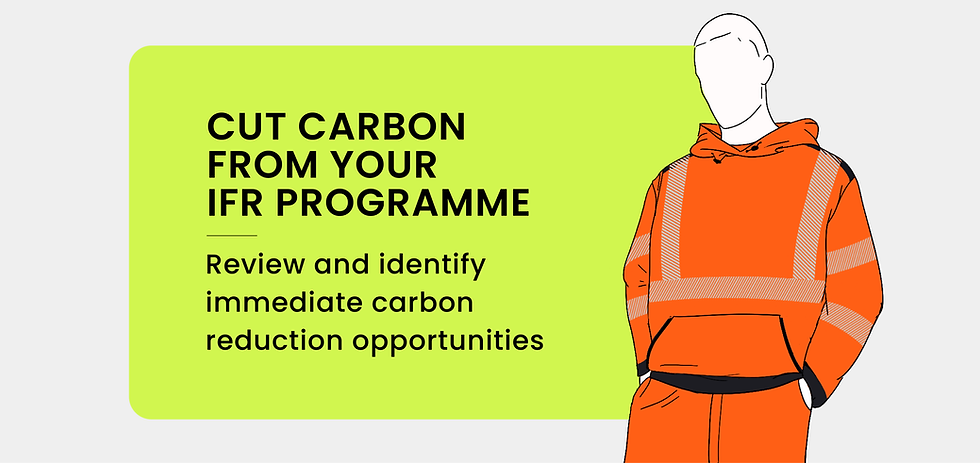
At industrial scale, these reductions become commercially and operationally significant. Deploying 10,000 Newport low carbon IFR coveralls reduces estimated embedded emissions by approximately 102 metric tonnes of CO₂e.
This changes the role of protective clothing within industrial sustainability strategy. Uniform programmes become measurable decarbonisation opportunities rather than overlooked procurement categories.
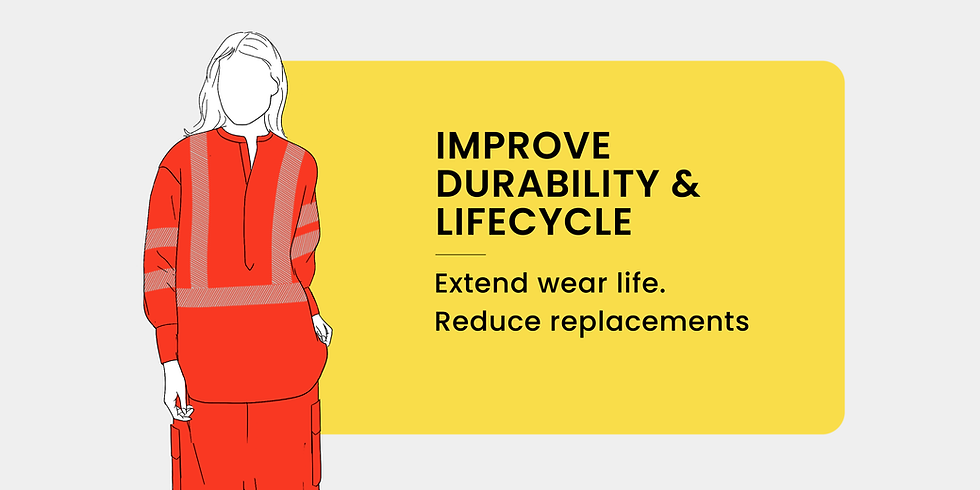
The reductions are achieved directly through the garment system itself. Our process integrates recycled inputs, lower carbon spinning, alternative energy dyeing, and fabric processing, engineered fabric constructions, and European made fabrics to reduce embedded emissions at source. This is not dependent on carbon offsets, theoretical lifecycle assumptions, or future technologies. The reductions are embedded within products that can already be specified, purchased, deployed, laundered, and scaled today.
The platform has also been engineered around real industrial safety requirements. The garments are designed to address hazards including arc flash, flash fire, molten metal, rain, moving traffic, low visibility, potentially explosive environments, and chemical splashes. Products are built around recognised standards including ISO 11612, IEC 61482, EN 1149-5, ISO 13034, EN 343, EN ISO 20471, and RIS-3279-TOM where required.
This matters because procurement teams, PPE brands, and industrial uniform suppliers are increasingly being asked how their products contribute towards ESG objectives, Scope 3 reductions, and industrial decarbonisation targets. Most suppliers do not yet have a commercially deployable answer.
Dobtho does.
Our low carbon IFR platform is available through fabric supply, finished garment supply, private label collaborations, and custom specification development. This enables uniform companies, workwear brands, distributors, and OEM partners to introduce low carbon inherently flame resistant workwear into their own product portfolios without rebuilding their supply chain infrastructure from the ground up.
For industrial end users, the outcome is direct: measurable carbon reduction from PPE and uniform programmes without compromising protection, durability, or operational performance. For uniform companies and workwear suppliers, the outcome is equally clear: stronger differentiation, improved sustainability positioning, and access to a new generation of industrial workwear products already engineered for deployment.
Protective clothing has been missing from the climate conversation because the category was considered too technical, too regulated, and too difficult to change.
Our platform proves otherwise.
The products exist.
The reductions are measurable.
The system is deployable now.
The transition has already started.