Women friendly PPE design in inherently flame resistant workwear


In 2026, with billions of pounds invested in the global PPE industry, most protective clothing is still designed around a single standard. This is not a technical limitation. It is a design decision.
Protective clothing is expected to perform in high risk environments. Yet it is routinely issued in forms that do not fit a portion of the workforce. For women, this often means garments that are oversized, poorly balanced and incorrectly proportioned. The result is not just discomfort. It is restricted movement, excess material, incorrect positioning of protective elements and reduced usability in real working conditions.
In inherently flame resistant workwear, these issues are amplified. Garments that do not sit correctly can interfere with movement, layering and visibility. They are more likely to be adjusted, worn incorrectly or avoided altogether. This creates a gap between certified performance and actual use.
This has been known for years.
At Dobtho, inclusive design is not treated as a feature or a differentiator. It is a requirement. Protective clothing that does not account for different body shapes, sizes and users is incomplete by definition. We design systems on that basis.
It should not be unusual.
BS 30417:2025 defines inclusive PPE as equipment that provides equitable access to correctly fitting protection across a diverse workforce, without compromising performance or introducing secondary risks. This is the baseline. The expectation is clear. PPE must be fit for the people wearing it.
Most PPE systems still rely on scaled versions of men’s garments. This approach does not meet that requirement. Inclusive PPE requires garments that are shaped for different body proportions, systems that maintain consistent protection across all users and product platforms that allow multiple fit options without increasing complexity. The shift is not about adding more products. It is about designing systems correctly from the start.
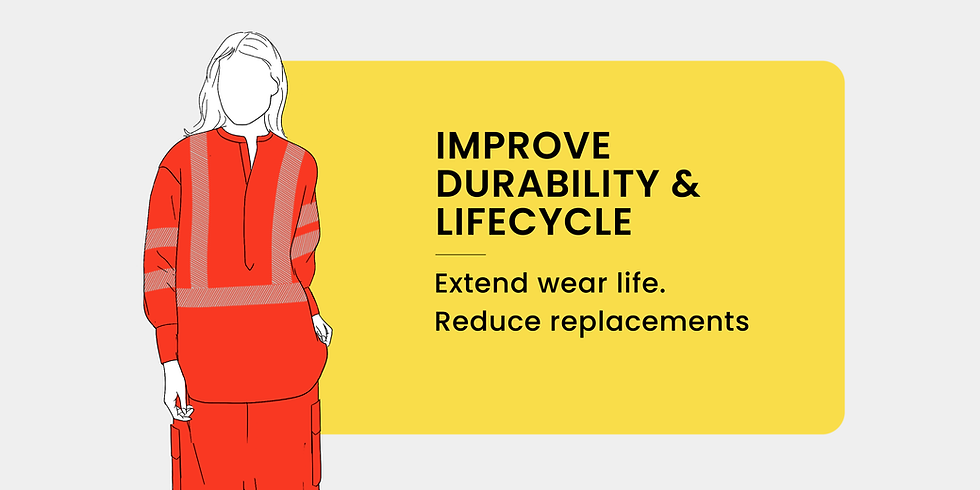
Within the Dobtho low carbon IFR range, this is implemented through the development of both dedicated women’s garments and universal fit products. Women specific PPE garments are developed using separate pattern blocks to reflect body shape and movement. Examples include the Vienna soft touch relaxed IFR shirt, Barcelona hardwearing IFR crease pants, Kendal soft touch pro vis IFR top and Cannes soft touch pro vis IFR barrel trousers. These garments are shaped to accommodate chest, waist and hip proportions, with adjustments to rise, seat, sleeve length and shoulder width. This ensures that garments remain correctly positioned during movement while maintaining full inherent flame resistant protection and visibility compliance.
Alongside this, universal garments are designed to support deployment across mixed workforces. Products such as Tallinn soft touch IFR hooded fleece, Reims soft touch IFR joggers, Koper soft touch IFR polo and Antwerp Anyday IFR polo are structured to accommodate a wider range of body types within a single fit format. This enables consistent rollout across teams without fragmenting procurement or increasing stock complexity. Inclusive design is delivered through a combination of tailored garments and universal systems, rather than a single approach.
PPE must perform in real working conditions. This includes long shifts, repeated movement and industrial laundering. BS 30417:2025 makes it clear that comfort and protection must be achieved together, as poorly fitting PPE reduces effectiveness and introduces additional risks. Dobtho integrates soft touch fabric constructions, balanced garment structures and controlled pattern design to support continuous wear. Our products such as Tallinn hooded fleece, Reims joggers and Koper polo are designed to reduce pressure points, support movement and maintain comfort over extended use. Performance is maintained in use, not just at specification level.
Inclusive PPE design must not compromise protection. The IFR system maintains inherent flame resistance and covers multiple hazards including arc flash, flash fire, environmental exposure and chemical risks. It is available in both high visibility and non high visibility formats, ensuring that protection remains consistent across different roles and operating environments. There are no variations in protection performance between women specific and universal garments. Fit does not come at the cost of safety.
BS 30417:2025 sets out guidance for inclusive PPE selection, fitting and deployment, including the provision of multiple options, support for comfort and mobility and compatibility across PPE systems. Our system is structured to align with these requirements. Inclusive design is integrated at product level, supported through a coordinated range and ready to be deployed across uniform programmes without disruption.
Women friendly PPE design must also work at scale. Organisations require systems that can be implemented without increasing complexity or changing procurement structures. Dobtho's low carbon IFR range enables deployment across large programmes, integrates with existing supply chains and supports consistent availability of inclusive PPE. This ensures that inclusive design is not limited to small batches or exceptions, but becomes part of standard issue.
Protective clothing that does not fit is a design failure. Inclusive design is not a feature. It is a requirement.